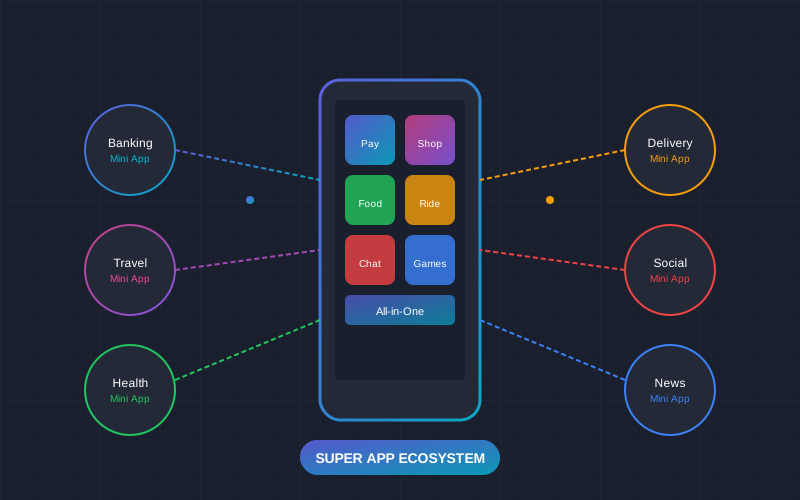
Imagine a single app where you can pay for coffee, order a taxi, buy concert tickets, chat with friends, and invest in stocks - all without leaving one application. This isn't a future vision - it's the super apps reality that's already changing the daily lives of billions in Asia and rapidly spreading to Europe. In 2026, the super apps model is becoming increasingly relevant for Western businesses, making it time to deeply understand this phenomenon.
What Is a Super App?
A Super App is a mobile application that combines multiple services on a single platform. Instead of downloading dozens of separate apps for different needs, a super app provides everything in one place: payments, e-commerce, transportation, food delivery, messaging, entertainment, and more.
The term "super app" was first used by BlackBerry founder Mike Lazaridis, who predicted in 2010 the emergence of apps combining many functions in one place. However, the true super app model was created by Chinese company Tencent with their WeChat platform.
The World's Largest Super Apps
WeChat (China) - The Super App Pioneer
WeChat - 1.3 billion users
Region: China and Chinese diaspora worldwide
WeChat started as a messaging app in 2011, but today it's an entire digital ecosystem:
Services: messaging, social network, payments (WeChat Pay), e-commerce, taxi, food orders, utility payments, investments, banking, health services, government e-services, mini programs
WeChat statistics are staggering: 88% of Chinese smartphone users use WeChat daily, spending an average of 82 minutes per day. The platform hosts over 4 million mini programs (mini apps), allowing access to virtually any service.
Grab (Southeast Asia)
Grab - 187 million users
Region: Singapore, Malaysia, Indonesia, Thailand, Vietnam, Philippines
Grab started as a taxi app (similar to Uber), but expanded into a full super app:
Services: taxi and ride-hailing, food delivery (GrabFood), package delivery, payments (GrabPay), insurance, investments, loans, e-commerce
Gojek (Indonesia)
Gojek - 170 million users
Region: Indonesia, Singapore, Vietnam
Gojek's uniqueness - started from motorcycle taxi services, which are very popular in Indonesia:
Services: motorcycle taxi, food delivery, packages, payments (GoPay), tickets, cleaning services, massage, beauty treatments at home, medicine delivery
Revolut (Europe)
Revolut - 45 million users
Region: Europe, USA, Australia, Japan
Revolut - Europe's answer to Asian super apps, focused on financial services:
Services: banking, currency exchange, cryptocurrencies, stock investments, insurance, travel insurance, hotel bookings, loyalty programs, business accounts
Super Apps vs Traditional Apps
| Aspect | Traditional App | Super App |
|---|---|---|
| Functionality | One main function | Dozens of integrated services |
| User experience | Need to switch between apps | Everything in one place |
| Data integration | Isolated data | Shared user data |
| Payments | Separate payment methods | Integrated payment system |
| Development costs | $5,000-$50,000 | $100,000-$1,000,000+ |
| User LTV | Low-medium | Very high |
Mini Apps - The Foundation of Super App Ecosystems
Mini Apps are lightweight applications running inside the super app platform. They're not installed separately - users open them directly within the super app, and they use the main platform's infrastructure.
Mini Apps Advantages
- Quick access - no download and installation required
- Small size - typically up to 10 MB (vs 50-100 MB for traditional apps)
- Infrastructure access - payments, authentication, notifications already prepared
- Large audience - immediate access to entire super app user base
- Lower development costs - 5-10x cheaper development than standalone app
WeChat Mini Programs Statistics
- 4+ million active mini programs
- 450 million daily active users
- Average development time: 2-4 weeks
- Development costs: $2,000-$10,000 (vs $20,000-$100,000 for standalone app)
Why Are Super Apps Popular in Asia?
The super apps phenomenon arose in Asia due to several unique factors:
1. Mobile-First Market
Many Asian users first connected to the internet via smartphone, not computer. In China, 99.7% of internet users use mobile devices. This created a unique environment where mobile apps became the primary digital tool.
2. Weak Traditional Banking
In many Asian countries, traditional banking was underdeveloped, so mobile payments became the primary financial infrastructure. In China, 80% of all payments are made through WeChat Pay and Alipay.
3. High Population Density
High population density in urban areas enables efficient delivery services - the foundation for many super app functions.
4. Regulatory Environment
The Chinese government encouraged local tech companies, and restricting foreign competitors (Google, Facebook) allowed local super apps to dominate.
Super Apps in Europe: Challenges and Opportunities
Europe has a different situation than Asia, so the super apps model is being adapted:
European Super Apps Challenges
- GDPR regulations - strict data protection requirements limit data sharing between services
- Fragmented market - different languages, regulations, and payment systems in each country
- Developed banking - strong traditional financial institutions compete with fintech
- Privacy culture - European users are more sensitive to data collection
Despite challenges, Europe has advantages - strong fintech sector, high digital literacy, and unified payment area (SEPA).
European Super Apps Examples
| Company | Initial Focus | Super App Direction | Users |
|---|---|---|---|
| Revolut | Currency exchange | Financial super app | 45M |
| Klarna | Buy now, pay later | Shopping super app | 150M |
| Bolt | Taxi | Mobility super app | 100M |
| N26 | Mobile banking | Financial management platform | 8M |
Building a Super App: Technical Architecture
Microservices Architecture
A super app cannot be monolithic - it must be built on microservices architecture, where each service (payments, transportation, food) is a separate module.
Key Super App Components:
- Authentication service - single sign-on for all services (SSO)
- Payment service - integrated wallet, cards, bank integrations
- Notification service - push, SMS, in-app notifications
- Mini Apps container - environment to run mini programs
- API Gateway - centralized access to all services
- Data platform - analytics, personalization, ML models
Technology Stack
| Layer | Recommended Technologies |
|---|---|
| Mobile App | Flutter (cross-platform), React Native, or Native (Swift/Kotlin) |
| Backend | Node.js, Go, or Java (Spring Boot) for microservices |
| API | GraphQL + REST, gRPC between services |
| Databases | PostgreSQL, MongoDB, Redis (cache) |
| Infrastructure | Kubernetes, AWS/GCP/Azure, Terraform |
| Mini Apps | WebView + Custom SDK, or React/Vue mini framework |
Super App Monetization Models
Super apps have unique monetization opportunities due to high user traffic and data:
1. Transaction Fees
Commission from every payment or transaction on the platform. WeChat Pay charges 0.1-0.6% commission on commercial transactions.
2. Subscriptions
Premium features, business accounts, additional services. Revolut Premium - £7.99/month.
3. Mini Apps Commissions
Commission from mini program sales (typically 5-30%). Apple App Store model, but inside the super app.
4. Advertising and Data
Targeted advertising based on user behavior. Requires careful GDPR consideration.
5. Financial Services
Loans, insurance, investments - high-margin products with strong user data foundation.
Frequently Asked Questions (FAQ)
Conclusions and Future Perspectives
The super apps phenomenon is changing how people use mobile devices. While directly transferring the full Asian model to Europe and the West is difficult due to regulatory and cultural differences, super app principles - service integration, unified user experience, and data-driven personalization - are becoming increasingly important.
For Western businesses, we recommend:
- Monitor the market - follow Revolut, Bolt, and other European super apps development
- Think about integrations - could your service be a mini app on another platform?
- Evaluate niche opportunities - vertical super apps for specific sectors
- Invest in APIs - open integrations allow becoming part of the ecosystem
The future of super apps in Europe will likely not be one dominant platform, but several specialized super apps for different needs - finance, mobility, health. And Western businesses have the opportunity to be part of this transformation.
Want to Build a Super App or Mini App?
Contact us for a free consultation. We'll help evaluate your business opportunities in the super app ecosystem and create a strategy.
Get Free Consultation