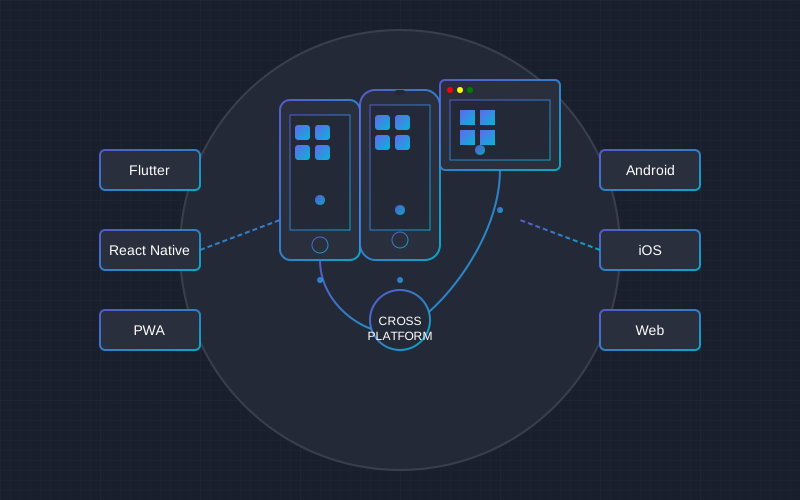
Every other business owner I speak with asks me this question. And most of them expect a simple "yes" or "no." But real life is not that straightforward.
Honestly, most businesses do not need a mobile app. And I say this as someone who makes a living building them. But I would rather be honest and lose a client than build an app that gathers dust in the Google Play Store.
So when is an app actually worth the money? Let us find out.
First -- Let Us Stop Romanticizing Apps
Here is what typically happens: a business owner sees that a competitor has an app. Or a friend says, "You need an app." Or someone reads that we are living in the "mobile-first era." And then they call me -- "I want an app."
Fine. But when I ask, "What would this app do that your website cannot?" the answer is often silence.
And that is perfectly okay. Nobody is born knowing when an app makes sense and when it does not. But if you are reading this article, you are already thinking in the right direction. So let me help you figure it out.
When an App Will Genuinely Pay Off
Over several years I have seen dozens of projects -- some worked, some did not. Here is what I have noticed: an app succeeds when the customer uses your service regularly.
Business types where an app delivers real value
- Restaurants and cafes -- order placement, menus, loyalty cards. Customers open the app every week to order. That works.
- Gyms and fitness studios -- class schedules, booking, membership management. Members check the app every morning to plan their day.
- Beauty salons -- online booking, reminders, discounts for regulars. A client books in 30 seconds instead of making a phone call.
- Logistics and courier services -- route planning, parcel tracking, driver management. Here an app is not optional -- it is essential.
- Internal operations -- warehouse tracking, employee scheduling, reporting. When 10 people use it daily, the investment pays off fast.
See the common thread? Repeat usage. If a customer interacts with your business at least once a week, an app makes sense. If they buy once a year, it does not.
When an App Is a Waste of Money
These are not bad businesses. An app is just not the right tool for them.
You are better off investing elsewhere
- Real estate agencies -- someone looks for an apartment maybe once every five years. They do not need your app. A well-optimized website with strong SEO is where the money is.
- Furniture stores -- same idea. People buy a sofa once a decade. An app will sit on their phone and never be opened.
- Law firms -- your clients do not need a lawyer app. They need to find you quickly on Google and call.
- Construction companies -- a roof gets built once in a lifetime. Good Google Ads and a portfolio on your website will outperform any app.
A former client -- a small seaside restaurant -- came to me wanting "an app like Uber Eats." I asked how many daily orders they handled. About 15-20. I advised starting with a simple order form on their website with SMS notifications. It cost ten times less than an app, and the result was the same.
Six months later, when daily orders grew to 60-80, we built them a proper Android app. And then it made sense, because people were using it every day.
Android or iOS -- What to Choose?
In Europe, the split between Android and iOS varies by country. But those aggregate numbers can be misleading because it depends heavily on your specific audience.
| Factor | Android | iOS |
|---|---|---|
| European market share | ~55-65% (varies by country) | ~35-45% (varies by country) |
| Development cost | Usually 10-20% cheaper | Slightly more due to Apple requirements |
| Publishing | Google Play -- 1-3 days | App Store -- 1-2 weeks (strict review) |
| Best for | Logistics, warehouses, manufacturing | Premium services, finance, urban consumers |
| Developer fee | $25 one-time | $99 per year |
My advice: if you are building an internal business app (warehouse, logistics, employee management), start with Android. It is cheaper, faster to publish, and most field workers use Android phones.
If you are building a customer-facing app (restaurant, gym), it depends on your audience. But I almost always recommend starting with one platform, seeing whether people actually use it, and only then expanding to the second.
Or Would a Website Be Enough?
Let us be honest. In 2026, a well-made mobile-responsive website can do 80% of what an app does. Especially if it is a PWA (Progressive Web App) -- it works offline, can send push notifications, and looks like a real app.
PWA advantages:
- No need to publish on Google Play -- works through the browser
- Costs 2-3 times less than a native app
- Works on both Android and iOS right away
- Updates are instant -- no waiting for app store approval
PWA disadvantages:
- No access to certain phone features (NFC, some sensors)
- iOS still restricts some PWA capabilities
- Some users are less trusting -- "Why is it not in the App Store?"
My take: if you are a small business and want to test the waters, start with a PWA. If people use it regularly, invest in a full native app. That is the smart path, and it is what I always recommend before spending 15,000 EUR on something untested.
What It Costs -- No Smoke and Mirrors
Since everyone asks about pricing, here are concrete numbers from real projects (2026 pricing, European market):
| Project Type | Price | Timeline |
|---|---|---|
| PWA (web app) | 3,000 - 8,000 EUR | 3-6 weeks |
| Simple native app | 5,000 - 15,000 EUR | 1-3 months |
| Medium complexity (with backend) | 15,000 - 30,000 EUR | 3-5 months |
| Complex system (integrations, AI) | 30,000 - 60,000+ EUR | 5-10 months |
And remember to add 15-20% per year for maintenance. Servers, updates, bug fixes. This is not a one-time investment -- it is like a car that needs regular service. We cover this in detail in our app maintenance cost guide.
5 Questions to Ask Yourself Before Building an App
Before calling any developer, answer these questions honestly:
- Would my customers use the app at least once a week? If not, you do not need an app.
- What will the app do that my website cannot? If you cannot answer, you do not need an app.
- Do I have budget for both development AND maintenance? An app without maintenance is a dead app within 6 months.
- Is my business already running steadily? If you are still fighting for customers, an app will not save you. Marketing comes first.
- Can I start with something smaller? A PWA, a chatbot, an automated form -- maybe that is enough to begin with.
If you answered "yes" to most of these, then it is worth having a serious conversation. If not, save your money and invest it where it will deliver the biggest return today. Maybe that is SEO. Maybe it is Google Ads. Maybe it is simply a better website.
So... Do You Need One or Not?
There is no universal answer to this question. But here is my simple test:
The quick test
If your customer interacts with your business more than once a week, an app is absolutely worth it. It will help you automate processes, increase loyalty, and ultimately generate more revenue than it cost to build.
If less frequently, invest in a solid website, SEO, and advertising. Save the app for later, when your business has grown enough to justify it.
And one more thing. If you have decided that an app is right for you -- do not rush. It is better to spend 2 months planning and 3 months building than 1 week planning and 6 months fixing. I have seen both approaches, and the first one always ends better.
If you want to discuss your specific situation, get in touch. The first consultation costs nothing, and if I see that you do not need an app, I will tell you straight. Long-term trust matters more to me than a one-time sale.
Frequently Asked Questions (FAQ)
Not sure if you need an app?
Let us have a 15-minute conversation. I will give you an honest answer -- whether it is worth investing now or better to wait. No obligations.
Get a free consultation