Here is a scenario I see regularly. A client invests 15,000 EUR into an app. Everything works beautifully. The client is happy. And then -- silence. No maintenance budget, no updates, no plan for ongoing support.
Eight months later, Apple releases a new iOS version. The app breaks. Users flood the store with 1-star reviews. The client calls in a panic -- "Why is everything broken?"
Nothing is broken. Nobody maintained it. And that is the single most common mistake I see with mobile apps. People think that once you build it, you are done. But an app is not a bookshelf. It is more like a car. It needs fuel, oil changes, and regular inspections.
So how much does that "inspection" cost? Let us look at the actual numbers.
The Core Rule: 15-25% Per Year
Based on industry standards and my own experience, app maintenance costs 15-25% of the original development cost every year. This is not a number I made up -- it is the reality across the industry.
Here is what that looks like:
| App Development Cost | Annual Maintenance (min) | Annual Maintenance (max) | Per Month |
|---|---|---|---|
| 5,000 EUR | 750 EUR | 1,250 EUR | 60-105 EUR |
| 15,000 EUR | 2,250 EUR | 3,750 EUR | 190-315 EUR |
| 30,000 EUR | 4,500 EUR | 7,500 EUR | 375-625 EUR |
| 50,000 EUR | 7,500 EUR | 12,500 EUR | 625-1,040 EUR |
So what exactly makes up that 15-25%? Let us break it down.
What App Maintenance Actually Includes
1. Servers and Infrastructure
Every app that has a backend (and that is most apps) needs somewhere to "live." Servers, databases, file storage -- all of it costs money every month.
| App Type | Server Cost Per Month |
|---|---|
| Simple app (up to 1,000 users) | 50-100 EUR |
| Medium app (1,000-10,000 users) | 100-300 EUR |
| Large app (10,000+ users) | 300-500+ EUR |
| Internal business system (up to 100 employees) | 30-80 EUR |
On top of servers, there are third-party services: push notifications (Firebase -- free up to a certain limit), maps (Google Maps -- 0 to 200 EUR/month depending on usage), SMS verification (0.03-0.05 EUR per SMS), and email delivery (10-30 EUR/month).
For most small and medium businesses, servers cost 50-150 EUR per month. These are not scary numbers. But you need to know about them.
2. OS Updates -- The Annual Headache
Every year Apple releases a new iOS version (in September), and Google releases a new Android version (typically in autumn). And every time, something changes.
Sometimes the changes are minor -- maybe a font size shift or a navigation animation tweak. Sometimes they are major. For example, when Apple introduced new privacy requirements in iOS 17, many apps had to rewrite portions of their code or face removal from the App Store.
What does this cost? It depends on the year:
- Good years (minor changes) -- 500-1,500 EUR per platform
- Bad years (major changes) -- 2,000-5,000 EUR per platform
- Worst-case years (fundamental API changes) -- 5,000+ EUR
If your app runs on both Android and iOS -- multiply by two. This is one reason I always recommend starting with a single platform.
What happens when you skip updates
I saw this firsthand with a restaurant app. The owner said "Why pay for maintenance? Everything works fine." After the iOS 18 update, the app started crashing every other launch. One-star reviews poured in within a week. By the time it was fixed -- three weeks later -- the rating had dropped from 4.5 to 2.8. It took six months to recover. Maintenance would have cost 200 EUR per month. The damage repair cost 4,000 EUR plus lost revenue.
3. Bug Fixes
Even a perfectly built app will have bugs. Not because the developer was bad, but because the real world is complicated. Users do things nobody anticipated. Networks drop unexpectedly. Phone models differ. Databases hit limits.
In the first months after launch, there will be more bugs -- that is normal. After 3-6 months, the system stabilizes and bugs become less frequent.
Typical bug-fix budget: 50-200 EUR per month in the first year, 30-100 EUR per month after that.
4. Security Updates
This is the part people ignore the most. And it is the most dangerous.
The programming libraries your app uses regularly receive security patches. If you do not apply them, your app retains "holes" that can be exploited to steal data, compromise your system, or cause other damage.
If your app handles personal information (names, emails, payments), GDPR requires that data be properly protected. A security vulnerability equals a potential GDPR fine.
Security update costs: 100-300 EUR per quarter. Not much, but essential.
5. Feature Updates and Improvements
This part is optional but highly recommended. Your users have ideas. The market evolves. Competitors add new features. If your app stays frozen for a year, it falls behind.
You do not need a revolution every month. But 1-2 small improvements per quarter keep the app "alive" and signal to users that someone is taking care of it.
Budget depends on your ambitions: from 0 EUR (if you need no new features) to several thousand per month (if you are actively evolving the product).
6. Monitoring and Analytics
Do you know how many people are using your app today? Where do they drop off? Which screen causes the most problems? If you do not know, you are flying blind.
Monitoring and analytics tools (Firebase Analytics, Crashlytics, Sentry) are mostly free or very inexpensive. But someone needs to review the data and respond. That is another 1-2 hours of developer time per month.
Maintenance Costs by App Complexity
Here is everything in one table for a clear comparison:
| Category | Simple App | Medium App | Complex App |
|---|---|---|---|
| Development cost | 5,000-10,000 EUR | 15,000-30,000 EUR | 30,000-60,000 EUR |
| Servers/month | 30-80 EUR | 80-250 EUR | 250-500+ EUR |
| OS updates/year | 500-1,500 EUR | 1,500-3,000 EUR | 3,000-6,000 EUR |
| Bug fixes/month | 30-80 EUR | 80-200 EUR | 200-400 EUR |
| Security/quarter | 100-200 EUR | 200-400 EUR | 400-800 EUR |
| Total per year | 1,500-3,500 EUR | 4,000-8,000 EUR | 8,000-18,000 EUR |
These figures do not include new feature development -- this is just the cost of keeping the app running, stable, and secure.
SLA Tiers -- What You Get for Your Money
When discussing maintenance with a developer, you will typically be offered different support tiers:
Basic Maintenance (from 150 EUR/month)
- Server monitoring and upkeep
- Critical bug fixes within 24-48 hours
- OS compatibility updates once per year
- Security patches every quarter
- Email support on business days
Premium Maintenance (from 400 EUR/month)
- Everything in Basic, plus:
- Critical bug fixes within 4-8 hours
- Proactive monitoring (alerts before problems become critical)
- Small feature improvements included (up to 4-8 hours/month)
- Phone support during business hours
- Monthly app health report
For most small and medium businesses, basic maintenance is more than enough. Premium makes sense if your app is a critical business channel (e.g., an e-commerce app that drives 50%+ of your sales).
How to Reduce Maintenance Costs
Now for the most important part -- how to pay less. Here is what experience has taught me:
1. Invest in quality code from the start
This sounds obvious, but it is true. A cheaply and quickly built app will cost more to maintain. Every "quick fix" is technical debt that you will pay back with interest.
I once took over a logistics app that another developer built for 8,000 EUR. In the first year, maintenance cost 6,000 EUR because the code was so fragile that every fix triggered new bugs. It would have been cheaper to invest 14,000 EUR in a quality product from the start.
2. Automated testing
Automated tests add 15-20% to the initial development cost. But afterwards, every time you update the code, the tests automatically verify that everything still works. That means fewer bugs, faster updates, and fewer developer hours.
If your app will live for more than 2 years, automated tests will pay for themselves 100%.
3. Right-size your servers
I often see apps running on servers that are 3-5 times too large. Say your app has 200 daily users, but the server is configured for 5,000. That is like renting a 200 square meter office for three people.
Cloud platforms (AWS, Google Cloud, DigitalOcean) let you start small and scale as needed. This can save 50-70% on server costs.
4. Cross-platform instead of native
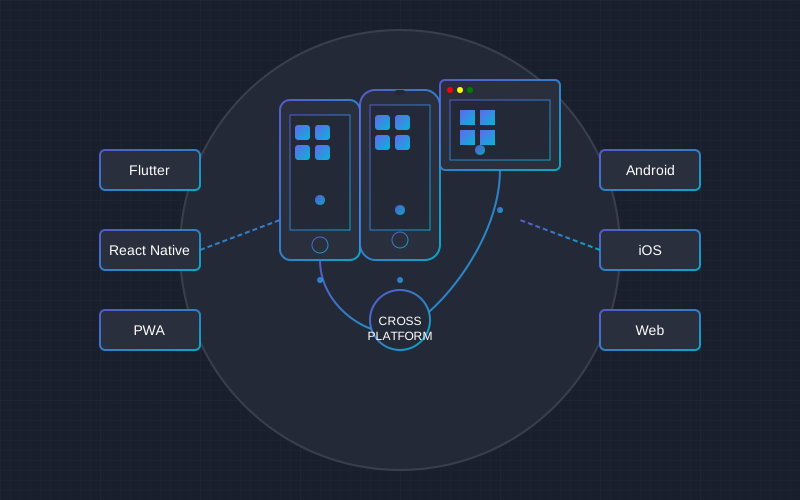
If your app needs to run on both Android and iOS, cross-platform technologies (React Native, Flutter) let you maintain a single codebase for both platforms. That means every fix is made once, not twice. Savings: approximately 30-40% on maintenance costs.
In 2026, cross-platform technologies are mature enough that native development is no longer necessary for the majority of projects.
5. Negotiate maintenance from day one
If you agree on a maintenance plan before development begins, you get a better price. The developer knows they have a long-term client and can offer a lower monthly rate. Win-win.
What Happens If You Do Not Maintain Your App at All
Maybe you are thinking: "Can I just leave the app alone and not maintain it?" You can. But here is what to expect:
- After 6-12 months -- a new OS update breaks something small. Maybe one screen looks off. Maybe one button stops working. Users will notice.
- After 12-18 months -- the app starts breaking more seriously. Crashes, slowdowns, non-functional features. Review ratings drop.
- After 18-24 months -- Google Play or the App Store may warn you or remove the app for not meeting new requirements (this happens increasingly often).
- After 24+ months -- rebuilding from scratch is cheaper than fixing what is left. Your entire original investment is lost.
A real-world cautionary tale
A sports club app built in 2023 for 12,000 EUR. The owner decided not to budget for maintenance. In early 2025, the app stopped working on new Samsung phones (Android 15 changes). Over 2 months of inaction, 30% of users deleted the app. "Reviving" the app cost 5,500 EUR. If they had been paying 200 EUR/month for maintenance, the problem would have been fixed in a day -- before users even noticed.
How to Plan Your Maintenance Budget
My recommendation: plan for maintenance from the very beginning, when you are calculating your app development budget. Here is a simple approach:
- Find out the development cost -- say, 15,000 EUR
- Add 20% per year for maintenance -- 3,000 EUR (or 250 EUR/month)
- Plan for at least 2 years -- that means your real app budget is not 15,000 EUR but 21,000 EUR
If 21,000 EUR is too much, consider starting with a simpler solution (a PWA or a smaller feature set) where both development and maintenance cost less.
The golden rule
If you cannot afford maintenance, you cannot afford an app. It is better to have a simple, well-maintained website than a complex, neglected application. A neglected app is not just wasted money -- it damages your brand.
The Bottom Line
App maintenance costs money. But it is neither scary nor unexpected -- if you plan ahead.
For a simple app: 100-250 EUR per month. A medium app: 250-500 EUR per month. A complex app: 500-1,500 EUR per month. These are numbers you can plan around, and they should not intimidate you.
If you are not sure what maintaining your app would cost, get in touch. I can review your existing application and tell you what it needs and what it would cost. If you are still in the planning phase, I can help you structure your budget so there are no surprises a year down the line.
Frequently Asked Questions (FAQ)
Need app maintenance support?
We will assess your app's current state and propose a maintenance plan tailored to your needs and budget. First consultation is free.
Get a free consultation