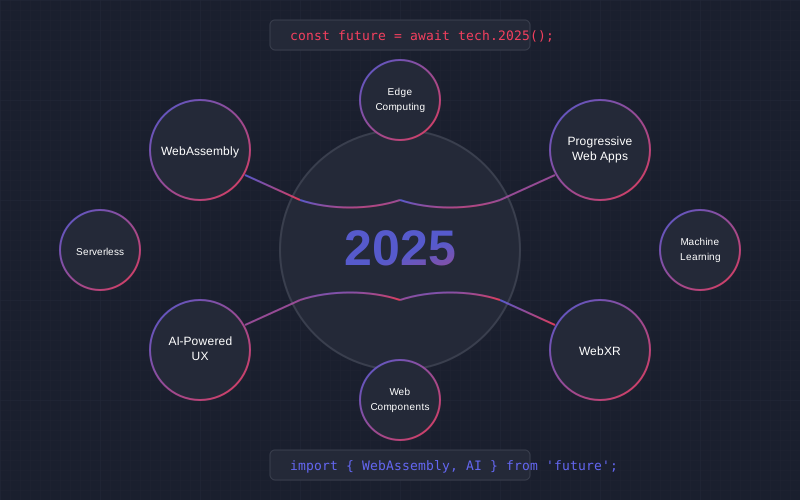
The web technology landscape is constantly evolving, and 2025 has already brought revolutionary changes that transform both user experience on the internet and developers' work. In this article, we'll review the most important web trends and technologies that will dominate in 2025, and how businesses can leverage them for competitive advantage.
Serverless and Edge Computing: New Web Paradigm
One of the most significant changes in 2025 is the convergence of serverless architecture and edge computing into a unified ecosystem:
1. Distributed Persistent Rendering (DPR)
In 2025, we see the adoption of a new generation rendering method – Distributed Persistent Rendering (DPR). This method combines:
- Static Site Generation (SSG)
- Server-Side Rendering (SSR)
- Client-Side Enhancement
- Edge Computing
Using DPR, pages are pre-generated and served from the nearest edge servers, but dynamically updated as needed. This ensures maximum speed while maintaining dynamic functionality.
2. Edge Function Mesh
Edge Function Mesh allows developers to create and deploy small code fragments that can run on servers located at any point in the world, closest to the end user. In 2025, we see that:
- 80% of API requests are processed at the edge level
- Latency has decreased to less than 50ms due to geographically distributed code execution
- Data localization allows easier compliance with various regional privacy requirements
Case Study
A Lithuanian fintech company "FinEdge" (name changed) moved its entire payment processing system to an edge functions infrastructure distributed across 15 regions worldwide. Result: payment processing time decreased by 78%, and system reliability increased to 99.999% availability. The ability to perform comprehensive data validation closest to the user, before passing information to the main system, played a particularly important role.
WebAssembly: The New Web Standard
WebAssembly (Wasm) reached maturity in 2025 and became a core technology enabling high-performance code execution in browsers:
1. WebAssembly System Interface (WASI)
WASI standardization enabled WebAssembly programs to securely access operating system resources and functionality, opening the door to new possibilities:
- Full desktop-quality applications running in the browser without installation
- Complex games and simulations without additional plugins
- Ability to perform large-scale computations on the client side
2. WebAssembly Component Model
The new component model transformed how applications are built:
- Language interoperability: ability to use components from various programming languages in one project
- Fast updates without full reload
- Less data transfer, as only what changes needs to be sent
In 2025, WebAssembly became extremely popular for data analysis, 3D visualization, and complex web application development, where performance close to native applications is required.
Web-Native AI: Artificial Intelligence Directly in the Browser
2025 is marked by the emergence of efficient AI models running directly in the browser:
- WebGPU API provides access to graphics processor power directly from JavaScript
- Compact transformer models (1-2GB in size) can run without a server
- Ability to perform complex image, audio, and text analysis while maintaining privacy
This opened the way for new types of applications:
- Real-time translation without external servers
- Photo and video editing using generative AI models
- Personalized virtual assistants running entirely client-side
Interesting Fact
At the beginning of 2025, an important milestone was reached – the first full-featured large language model (LLM) capable of running fully offline in the browser, using WebGPU and optimized 8-bit quantization. Although its capabilities were less than server-based LLMs, its operation without internet connection and complete privacy opened new possibilities for applications working with sensitive information.
Web Components and Component Design
In 2025, web components achieved complete standardization and broad support:
1. Universal Components
- Components can be used with any frontend framework or without one
- Significantly reduced JavaScript amount due to native component support
- Approximately 60% of new projects use web components as the primary UI building method
2. Component Ecosystem
Standardized component libraries emerged, working across all platforms:
- Open Web Components Registry – a centralized place with thousands of high-quality components
- Design systems that work with any frontend framework
- Automatic adaptation to various devices and platforms
CSS Evolution
In 2025, the CSS platform reached a new level of maturity:
1. Container Queries and CSS Consistency Model
Container Queries allow styling based on parent element size, not window:
- Components can independently adapt based on where they are placed
- Better component structure and reusability
- Less duplicated code
2. Cascade Layering and CSS Isolation
Cascade Layers (@layer) and the new Scoped CSS enable:
- Precise control of CSS rule priorities
- Isolated component styles, avoiding conflicts
- Creating modular design systems
3. Advanced CSS Algorithms
New CSS features allow performing complex calculations and creating dynamic designs:
- @when/@else conditions inside CSS
- CSS custom functions – ability to create your own functions for style generation
- Full Subgrid support, enabling complex grids
Privacy Technologies
In 2025, privacy became an integrated part of the web platform:
1. Private State Tokens
Replacing third-party cookies, Private State Tokens allow:
- Verifying user authenticity without tracking
- Protecting against fraud while maintaining anonymity
- Performing financial operations without long-term profiling
2. Local-First Web Apps
Local-first applications became a popular approach:
- Data is primarily stored in the local environment
- Synchronization with server occurs only while ensuring privacy
- Ability to work without internet connection and have full data control
Real-Time Web and WebTransport
The WebTransport protocol changed real-time communication on the internet:
- Lower latency than WebSockets (up to 30-50% faster)
- Multiplexing – many independent data streams in one connection
- Guaranteed and unguaranteed data transmission options
- Improved quality of video conferencing, games, and real-time collaboration tools
Interoperability and Web Platform
In 2025, significant progress was made in cross-platform compatibility:
1. Progressive Web Apps 2.0
The new PWA generation provides an almost indistinguishable experience from native:
- Access to all device functions (camera, microphone, GPS, file system)
- Background synchronization and notifications
- Seamless installation and integration with the operating system
- Web API unification across all browsers
2. Fugu API
Project Fugu brought many new possibilities:
- File System Access API with full file system access
- WebNFC, WebUSB, and WebBluetooth APIs for physical devices
- Background Fetch and Periodic Background Sync
- Native File System API
What This Means for Business in 2025?
These technologies open new opportunities for businesses:
1. Lower Development and Maintenance Costs
Edge computing and serverless technologies reduce infrastructure costs and management complexity, while WebAssembly and component development enable faster application creation with smaller teams.
2. Better User Experience Metrics
Fast, reliable, and constantly available applications increase conversions, user retention, and satisfaction. 2025 research shows that web applications using new technologies achieve 15-25% higher conversion rates.
3. Less Dependence on Third Parties
Local-first applications and privacy technologies allow companies to control their data and depend less on major technology platforms, as well as easier compliance with GDPR and other privacy regulations.
4. New Business Opportunities
Web-Native AI and WebAssembly open the way for new types of products and services that were previously only available as native applications.
Conclusions
2025 marks a significant transformation of the web platform, where the boundary between web and native applications disappears, and the browser becomes a universal software platform. New technologies enable creating faster, more secure, and more privacy-protecting applications that can run on any device and any platform.
Businesses that first adopt these technologies will be able to create better user experiences, optimize their processes, and discover new business opportunities. The WebXpert team continuously follows these technology trends and helps clients create modern, efficient, and competitive internet solutions.
If you want to learn more about how these new web technologies can be applied in your business, contact the WebXpert team. We can help you create a modern web strategy that leverages all the advantages of the latest technologies.
Related Articles
Cybersecurity 2025
Latest cybersecurity challenges and how to protect your business from cyber threats.
Read
Artificial Intelligence in Business
How to leverage artificial intelligence capabilities for more efficient business process management.
Read
E-commerce Optimization
Practical tips on how to optimize your e-commerce platform for maximum conversions.
Read