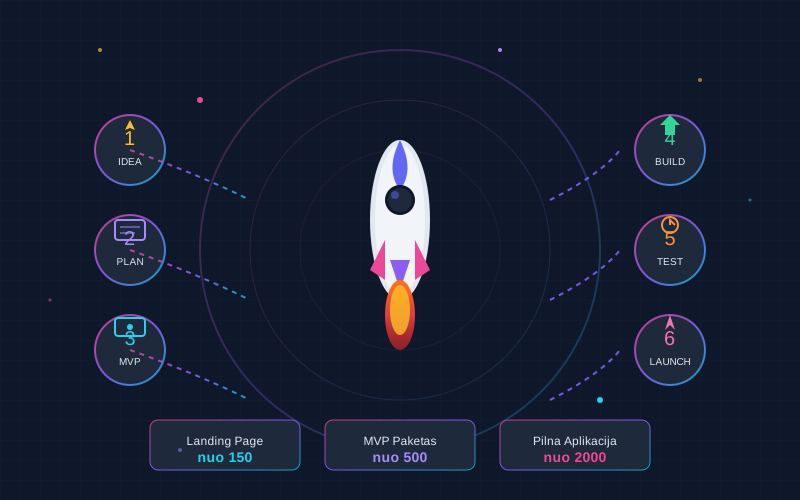
Six months ago, I met two guys who had a "brilliant idea" -- a platform connecting dog owners with dog walkers. The full vision: ratings, payments, GPS tracking, cameras on the collar, AI recommendations, a social network for dog owners.
They asked how much. I said -- with everything, 45,000-60,000 EUR and 6-8 months of work. Their eyes dropped. Their budget was 10,000 EUR.
But the story has a happy ending. We built an MVP in 5 weeks for 8,500 EUR. Just search, profiles, and booking. No AI, no cameras, no social network. After 3 months, they had 340 active users and secured investment for version two.
That is what an MVP is. And that is why it works.
What Is an MVP and Why It Is Not a "Bad Product"
MVP stands for Minimum Viable Product. But most people misunderstand it. They think it means a "crappy app" or a "half-finished project."
No. An MVP is the smallest version that solves the core problem. It works. It looks decent. It just does not have everything you envision for the future.
Think of it this way: if your idea is a ride-hailing platform, the MVP is not "a ride-hailing platform without a steering wheel." The MVP is "I can hail a ride and pay for it." Period. Everything else comes later.
The "Pizza Box" Method
My favorite way to identify MVP features -- the pizza box test. Take a pizza box (or a sheet of A4 paper) and write down everything your app needs to do.
If it does not fit, it is too much. Cross things out. Keep only what is necessary for the user to get value. And from what remains -- cross out another third.
What is left is your MVP.
Why Startups Fail Without an MVP
The statistics are brutal -- 90% of startups fail. But do you know the most common reason? Not lack of money. Not a bad team. It is that the market does not want their product.
And that is exactly where an MVP is a lifesaver. Instead of spending 8 months building a "perfect" product that nobody might want, you launch a minimal version in 4-6 weeks and see if people actually use it.
If they do -- invest more. If they don't -- pivot or stop. But you have lost 8,000 EUR, not 50,000 EUR. That is the difference between a "lesson" and a "disaster."
I have seen both scenarios. One startup spent 9 months building a "perfect" restaurant platform. When they launched, nobody used it because the target audience (small restaurants) simply did not need such a complex solution. 35,000 EUR -- down the drain.
Another founder built a parking app as an MVP in 4 weeks for 6,000 EUR. Launched it, saw that people wanted it -- but a different feature than he expected. Adjusted, and now has 2,000+ users.
What to Include in Your MVP (and What to Skip)
This is the biggest challenge. Every startup founder believes all 15 of their features are "essential." But the truth is -- most features are not necessary at launch.
Typical MVP Feature Set
- Registration and login -- essential. But email + password is enough. Social login can wait for version two.
- Core feature -- the one thing the app exists for. Booking? Search? Ordering? One thing that solves the problem.
- Basic profile -- who you are, key info. No avatars, no bio, no labyrinth of settings.
- Notifications -- push notifications for the most important events. That is it.
What You Do NOT Need in an MVP
- Payment system -- if you can handle the first 100 orders manually or via bank transfer. Stripe integration can wait.
- Chat feature -- give users a phone number or WhatsApp link. Cheap and it works.
- AI/ML features -- recommendations, personalization -- all of this requires data. Which you do not have yet. Collect data first, add AI later.
- Admin panel -- for the first 2-3 months, you can manage everything through the database or a simple admin interface. A complex dashboard comes later.
- Multi-language support -- start with one language. If your market is the US, launch in English. Add languages when you expand.
How Much Does an MVP Cost -- Real Prices
| MVP Type | Price | Timeline | Example |
|---|---|---|---|
| Micro MVP | 3,000 - 5,000 EUR | 2-3 weeks | Landing page + waitlist + simple booking |
| Standard MVP | 5,000 - 10,000 EUR | 4-6 weeks | App with registration, core feature, and notifications |
| Extended MVP | 10,000 - 15,000 EUR | 6-8 weeks | App with backend, user roles, basic payments |
Compare this with a full product that costs 30,000-60,000 EUR and takes 4-8 months to build. An MVP is a 5-10x cheaper way to find out if your idea works.
The 4-8 Week Process: What It Looks Like
Many people think 4 weeks is unrealistic. But when you know what you are doing and the client collaborates -- it is completely achievable. Here is how it works:
Week 1: Planning and Design
First meeting -- 2 hours. We discuss the idea, target audience, MVP features. Using the same "pizza box" method, we keep only the essentials.
The next day, I prepare wireframes -- sketches of how the app will look. Not a perfect design -- a structure. The client approves or adjusts. By day three, we have the final UI design for the key screens.
Weeks 2-4: Development
This is where the real work happens. Every week, the client sees progress -- not a "surprise" after a month, but weekly demos. "Here is registration working. Here is search. Here is the booking flow."
If something is off, we adjust immediately, not at the end of the project. This saves time and nerves on both sides.
Week 5 (or Week 4 if Things Go Well): Testing and Launch
Beta test with 10-20 real users. Not friends and family -- actual potential customers. Their feedback is gold.
We fix critical bugs and publish to the app store. The review process takes 1-3 days -- and the app is live.
How to Validate Your Idea BEFORE Building an MVP
Even an MVP costs money. So before investing 5,000-10,000 EUR, it is worth checking whether the idea has a chance.
Here is what I do with my clients:
- Landing page test. Create a simple page that describes the product with a "Sign Up" button. Run Google Ads for 200-300 EUR. If 5%+ of visitors click -- the idea has potential. Costs 500 EUR and 3 days.
- "Wizard of Oz" method. Do manually what the app would automate. For example, if your idea is a dog walking platform -- spend the first 2 weeks connecting owners with walkers via WhatsApp yourself. If it works manually, it will work in an app.
- Competitor review analysis. Find similar apps in other countries. Read their 1-star reviews. The problems described there are your opportunities.
If after these tests you see that people want your solution -- go ahead with the MVP. If not -- you just saved 8,000 EUR.
The 5 Most Common MVP Mistakes
After years of working with startups, I have seen the same mistakes repeated:
5 Mistakes That Kill MVPs
- Too many features. "But without this feature, nobody will use it!" -- everyone says this. And almost everyone is wrong. Launch with less -- and see what users actually request.
- Pixel-perfect design first. An MVP does not need to be ugly -- but it does not need to be a Dribbble award winner either. Clean, understandable, functional. Polish comes in version two.
- Not measuring anything. You launch the MVP and then... look at nothing. How many users register? Where do they drop off? Which feature do they use most? Without analytics, an MVP is just shooting in the dark.
- Not listening to users. Users say "we want X," and you think "I know better." Maybe you do. But maybe you do not. At least listen.
- Taking too long to build. If your MVP takes more than 8 weeks, it is no longer an MVP. It is a product. Simplify.
After the MVP: What Comes Next
Good, you launched the MVP. You have your first users. Now what?
- Measure everything. Install analytics tools (Firebase, Mixpanel). Track where users drop off, what they use, what they ignore.
- Talk to your users. Your first 50 users are a gold mine. Ask them: what do they like, what do they not like, what is missing. Not through surveys -- call them and talk for 10 minutes.
- Iterate faster than planned. In the first month after launch, you should release at least 2-3 updates. Small but important -- based on user feedback.
- Grow organically. Your first 100-500 users should come through word-of-mouth, not advertising. If people do not recommend your product, the product is not there yet.
The MVP Success Formula
Fast launch + measurement + rapid iteration = success.
Not a perfect product from day one. But fast learning from the market. Every week after launch should give you a new insight about your users.
Real MVP Examples That Became Huge
If you think MVPs are only for "small players," remember:
- Airbnb -- started as a simple website where two guys rented out air mattresses in their apartment during a conference in San Francisco.
- Dropbox -- before building the product, the founder made a 3-minute video showing how it would work. The waitlist grew from 5,000 to 75,000 overnight.
- Uber -- the first version only worked in San Francisco and only let you send an SMS to request a black limousine. No map, no upfront pricing.
- Zappos -- the founder took photos of shoes in local stores and posted them online. When someone ordered, he went to the store, bought the shoes, and shipped them. Zero inventory.
Every one of these products started with an "embarrassingly simple" MVP. And that did not stop them from becoming billion-dollar companies.
Raising Investment with Your MVP
Here is something most startup founders do not realize: investors do not want to see a 50-slide pitch deck. They want to see a working MVP with 100+ users. That is the language they understand.
An MVP with traction proves three things investors care about:
- The problem is real -- people are actually using your solution
- You can execute -- you built something that works
- There is demand -- growth metrics show market pull
A well-executed MVP with 200-500 active users is far more convincing than any PowerPoint presentation.
Frequently Asked Questions (FAQ)
Conclusion: Stop Planning, Start Building
If you have an idea -- do not sit on it for a year planning. Go and build. Start with the landing page test -- 500 EUR and 3 days. If it works -- let us talk about the MVP.
If you are afraid that your idea is "too small" or "too simple" -- that is actually a good sign. Big ideas always look too simple in the beginning. Because if it looks complicated from day one, it is probably too complicated.
Have a startup idea?
Free 30-minute consultation: we will discuss your idea, define the MVP scope, and calculate the cost. No obligations.
Discuss your MVP idea