"How long will it take to build my app?" -- that is the very first question every client asks. And every time, I want to give a simple answer. But I cannot, because the real answer depends on a dozen factors that most clients have not even thought about yet.
To be honest, I have seen projects delivered in 3 weeks. And I have seen projects that dragged on for 14 months. Both were described as "simple apps." The difference? It was never about the technology -- it was about the people and the processes.
So in this article, I am going to give you realistic timelines. Not the ones that sound great on a sales call, but the ones that actually reflect the reality of app development in 2026.
What Makes Up the App Development Timeline
Most people assume that building an app means a developer sits down and writes code. But coding only accounts for about 40-50% of the total time. The rest goes to planning, design, testing, and that endless cycle of "we just need to tweak this one thing."
Here is what the real process looks like from start to finish:
1. Planning and Requirements (1-2 Weeks)
This is where we sit down and figure out exactly what the app needs to do. Who are the users? What are the core features? What integrations are needed (payments, SMS, maps)?
Most clients want to skip this stage. "I already know what I want, just start coding." I have tried working that way. It ends with the client realizing a month into development that they had something completely different in mind. And then we rewrite everything from scratch.
Good planning saves 30-40% of the total project time. It is not wasted time -- it is an investment. In a separate article, I covered in detail what to look for when hiring a developer -- including how a proper brief makes everything faster.
2. UI/UX Design (2-4 Weeks)
Wireframes, screen designs, and an interactive prototype that lets you "walk through" the app and feel how everything works. For a small app (5-8 screens) -- 2 weeks. For a more complex one (15-25 screens) -- 3-4 weeks.
Sometimes clients say: "I don't need design, just make it work." I can do that. But then users open the app, cannot figure anything out, and delete it within 30 seconds. I have seen it happen repeatedly -- one startup skipped the design phase and had to redo everything 2 months later. They spent twice the time they would have if they had done it properly from the start.
3. Development (4-16 Weeks)
This is the heaviest stage. How long it takes depends entirely on what you are building:
| App Type | Development Time | Example |
|---|---|---|
| Simple (informational) | 4-6 weeks | Cafe menu, contacts, news feed |
| Booking/ordering | 6-10 weeks | Salon booking, gym schedule |
| Payments and integrations | 10-14 weeks | E-shop, delivery app, loyalty system |
| Complex (multi-user, real-time) | 14-20+ weeks | Marketplace, logistics platform, social app |
And this is for a single platform -- Android or iOS. If you need both, multiply the timeline by roughly 1.5x (not 2x, because a lot of code can be shared with React Native or Flutter).
4. Testing (1-3 Weeks)
Testing sounds tedious, but without it -- disaster. During testing, we catch bugs that the developer missed because they know the code too well and always use the app the "right way."
My rule: I test with 5-10 people who have never seen the app before. I give them a task -- "order a coffee" -- and watch. What seems obvious to me is sometimes impossible for them to find.
For a small app -- 1 week of testing and fixing. For a complex one -- 2-3 weeks. And you should never cut this short -- it is cheaper to fix issues before launch than after.
5. Publishing and Launch (0.5-1 Week)
Google Play Store -- 1-3 days from submission. Apple App Store -- 1-2 weeks, because Apple reviews more thoroughly (and sometimes rejects over minor details).
For a first-time Apple submission, you need additional preparation: screenshots, descriptions, privacy policy. That also takes time -- a solid day of work.
Realistic Timelines by Project Size
When you add it all up, here is what you get:
Realistic Timelines from First Meeting to Launch
- Simple app (MVP) -- 6-10 weeks (1.5-2.5 months)
- Medium app -- 3-5 months
- Complex app -- 6-10 months
And these are with a normal, non-rushed pace. Can it be done faster? Yes. But then either quality suffers or costs rise (you need more people on the team).
For one client -- a restaurant chain -- we built an ordering app in 7 weeks. But they came with a fully prepared brief, knew exactly what they wanted, and responded to questions the same day. That is the ideal scenario, and it happens maybe 1 out of 5 times.
What Actually Causes Project Delays
Over the years, I have compiled a "Top 5" list of reasons projects take longer than planned. And -- spoiler alert -- none of them are the developer's fault.
5 Main Causes of Delays
- Unclear requirements. The client says "make it look nice" or "like Uber, but simpler." That is not a brief -- that is a dream. The more specific you are about what you want, the faster you will get it.
- Scope creep -- a constantly growing feature list. We started with 5 features. After a week, it is 8. After a month, 15. Every new feature adds 1-3 weeks. And suddenly a 2-month project becomes a 5-month one.
- Slow feedback. I send design mockups, the client responds 10 days later. I send a beta version -- silence for 2 weeks. During that time, my team moves on to other projects, and getting back into yours requires a "warm-up" period.
- Changing decision-makers on the client side. We started working with the marketing manager. A month in, the director shows up and says "I don't like it, let's do it differently." Three weeks of work lost.
- Third-party integrations. When you need to connect to a bank API, payment system, or another platform -- the delays are often not our fault. A bank's IT department can take a week or two to respond.
If you recognized a few of these -- do not worry. Most clients face the same issues. But now you know what to avoid.
How to Speed Up the Development Process
I cannot promise your app will be done in 3 weeks. But I can tell you how to save 20-40% of the time -- and this is not theory, these are proven strategies.
Have a Clear Brief from Day One
Write down (in a Google Doc, a notepad, anywhere): what are the 5 core features, who are the users, which devices is it for, what problem does it solve. The more specific you are, the fewer questions there will be and the faster work begins.
I have a 15-question brief that I give every client before starting. Filling it out takes 30-60 minutes. But it saves 2-3 weeks during the project.
Start with an MVP
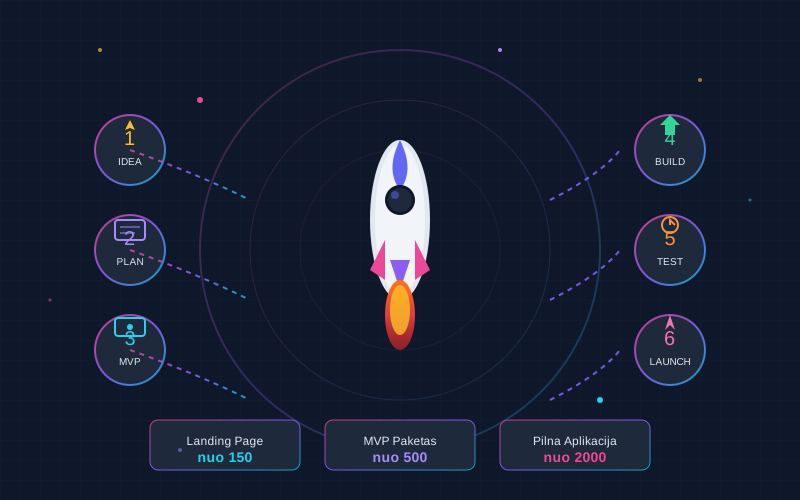
MVP stands for Minimum Viable Product. An app with the minimum set of working features. The idea is simple: launch with 3-5 core features, see if people use it, and then add the rest.
For one beauty salon, we built an MVP in 5 weeks -- just online booking and push notifications. Two months later, we added a loyalty program, and a month after that, a photo gallery. The salon started earning from the app from week one, instead of waiting 5 months for "everything to be perfect."
Respond Quickly
Answer questions within 24 hours. Review designs within 2-3 days, not 2 weeks. It is not difficult, but many clients push it off as "I'll look at it later." And that "later" costs money.
My best projects are the ones where the client responded the same day. The project moves like a train -- no stops, no waiting. And the result is always better.
Choose One Platform to Start
I know you want both Android and iOS. But start with one. Pick the one where more of your customers are. When one platform is running and being used, port it to the other. It is faster because you already know what works and what does not.
What the European Market Looks Like
App development timelines in Europe vary significantly depending on where you work. In Eastern and Northern Europe, timelines tend to be shorter than in Western Europe because teams are smaller and communication is more direct. There are no 5 layers of management between you and the person writing the code. You call -- and you talk to the developer.
Pricing is also more competitive. In Eastern Europe, the average hourly developer rate is 40-70 EUR. In London or Berlin, it is 90-150 EUR. The quality of the end product is comparable, but the cost difference is significant.
Typical Timeline for a Standard Project
1 week -- planning and brief
2 weeks -- UI design and prototype
4-8 weeks -- development
1-2 weeks -- testing and bug fixing
0.5 weeks -- publishing
Total: 8-14 weeks for a medium-complexity app. That is 2-3.5 months. Realistic? Absolutely. But only if the client and the team work in sync.
Red Flags When Getting Time Estimates
If a developer on the first call says "we'll do it in a month, no problem" -- run. Seriously. No professional gives an exact timeline without seeing detailed requirements. A separate guide on how to choose the right app developer covers this in depth.
A good answer sounds like this: "Based on what you have described, roughly 2-3 months. But I will give you a precise estimate after the planning phase when I know all the details."
That tells you the person has worked on real projects and understands that reality is always more complex than the first description.
So How Long Will My App Take?
If you are reading this and thinking about your own project -- here is my straightforward advice: take the timeline the developer gives you and multiply it by 1.3. That will be realistic.
Not because the developer is lying. But because there are always things nobody predicted -- client changes, third-party delays, unexpected technical issues. That is normal. That is life.
Quick Reference Formula
Simple app -- 2 months realistically (including preparation and testing)
Medium app -- 4 months realistically
Complex app -- 7-8 months realistically
And that is assuming you, as the client, actively participate in the process. If you "delegate and forget" -- add another 30%.
Frequently Asked Questions (FAQ)
Conclusions
Building a mobile app is not just about coding -- it is a multi-stage process that requires collaboration between you and the development team. The timeline depends as much on your responsiveness and preparation as it does on technical complexity.
Start with an MVP, keep the scope tight, give fast feedback, and you will have a working app in your hands far sooner than you think. The projects that drag on for months are almost always the ones that started without a plan.
If you want to talk about your specific idea -- get in touch. In 15 minutes, I can give you a preliminary timeline based on similar projects I have delivered. No obligations.
Want to know how long your project will take?
Tell us about your idea -- within 24 hours we will reply with a preliminary timeline and stage-by-stage plan. Completely free.
Get a timeline estimate