"How much does it cost to build an Android app?" -- I get this question every single week. And every time, the honest answer is: it depends. But I know that answer is useless on its own, so in this article I will lay out concrete numbers from real projects.
Not theoretical ranges plucked from thin air, but actual figures I have seen in the European market in 2026. Whether you are a startup founder, a small business owner, or a product manager scoping your next mobile project, this guide will give you the clarity you need to budget intelligently.
The Quick Answer -- If You Are in a Hurry
If you do not have time to read the full article, here is the bottom line:
Android App Development Costs in 2026
Simple app (digital business card, menu, contacts): 3,000 - 8,000 EUR
Medium complexity (user login, orders, payments): 8,000 - 20,000 EUR
Complex system (custom backend, integrations, AI): 20,000 - 60,000+ EUR
Plus 15-20% annually for maintenance and updates.
Now let us dive into what makes up that price -- and where you can realistically save money without cutting corners that matter.
What Goes Into the Price of an Android App
When I tell a client "15,000 EUR," the reaction is often the same -- "What exactly am I paying for?" Fair question. Let us break it down component by component.
1. UI/UX Design (15-25% of Budget)
This is not about making things "look pretty." UI/UX design determines how people will actually use your app. Where the buttons sit, how the checkout flow works, how many taps it takes to reach the goal. Good design is invisible -- bad design is why people uninstall your app after 30 seconds.
For a simple app, design typically costs 800-2,000 EUR. For a complex one, expect 3,000-8,000 EUR. In my experience, this is the last place you should cut corners. We once built a restaurant ordering app where the client insisted on doing the layout themselves. The result: a 2% order conversion rate. After bringing in a professional UX designer and restructuring the flow, conversions jumped to 11%. Design is not a luxury -- it is the difference between an app people use and one they delete.
2. Frontend Development (25-35% of Budget)
This is everything the user sees and interacts with: screens, animations, buttons, forms. The more screens your app has, the higher the cost. A useful rule of thumb: each screen costs between 200 and 800 EUR depending on complexity.
A simple app might have 5-10 screens. A mid-range app will have 15-30. A complex app can easily exceed 40. The math is straightforward from there.
3. Backend and Database (20-30% of Budget)
The backend is the server-side engine -- where data is stored, how authentication works, how orders are processed. If your app only displays static information (a menu, contact details), you barely need a backend. But once you add user accounts, payments, or an admin panel, a backend becomes essential.
Firebase or Supabase can cut backend costs by 30-50% for smaller projects. But if you are planning to scale, a custom backend will pay for itself in the long run. Choose based on your 2-year outlook, not just launch day.
4. Testing and Deployment (10-15% of Budget)
Testing across different Android devices, fixing edge-case bugs, and navigating the Google Play publishing process. The Google Play developer account itself is only a one-time $25 fee, but the review and approval process typically takes 1-3 days. Do not forget to budget for this phase -- rushed testing is the number one reason apps get poor reviews at launch.
5. Project Management (5-10% of Budget)
Communication, meetings, technical specifications, progress reports. At an agency, this is usually a separate line item. A freelancer often rolls it into their hourly rate. Either way, you are paying for it -- and good project management is what keeps timelines and budgets on track.
Pricing by Project Type -- With Real Examples
Let us stop talking in abstractions. Here are concrete examples of what different types of Android apps cost in the current European market.
| Project Type | Price Range | Timeline | Example |
|---|---|---|---|
| Informational app | 3,000 - 8,000 EUR | 3-6 weeks | Restaurant menu, company catalog |
| Ordering / booking app | 8,000 - 15,000 EUR | 2-3 months | Food delivery, salon booking |
| E-commerce app | 15,000 - 30,000 EUR | 3-5 months | Online store with payments, cart |
| SaaS / Marketplace | 25,000 - 50,000 EUR | 4-7 months | Service platform, B2B system |
| Complex enterprise system | 40,000 - 60,000+ EUR | 6-10+ months | Logistics with GPS, AI integration |
Keep in mind that prices can vary 20-30% depending on your developer's location. Western European agencies typically charge more than Eastern European ones, but talent concentration and communication standards also differ. The cheapest option is rarely the most cost-effective.
Hidden Costs Nobody Talks About
This is where many developers stay silent. I would rather you know upfront than discover these costs after your budget is already spent.
What Else Costs Money Beyond Development
- Servers and infrastructure: 30-300 EUR/month depending on load. For a small app, AWS or Google Cloud might cost 30-50 EUR/month. As you scale, expect 100-300 EUR/month.
- Maintenance and updates: 200-1,000 EUR/month. Android releases new OS versions regularly, and your app needs to stay compatible. Security patches, bug fixes, and minor improvements are ongoing.
- Google Play fee: $25 one-time. But if you process payments through Google Pay, Google takes a 15-30% commission on in-app purchases.
- Push notification services: Firebase Cloud Messaging is free up to certain limits. Beyond that, costs are roughly 0.01 EUR per notification.
- Third-party APIs: Payment processors (Stripe, PayPal) charge 1.4-2.9% per transaction. Google Maps is free up to 28,000 requests/month, then billed per use.
In short, add 15-20% annually on top of your development cost for ongoing maintenance. If your app cost 15,000 EUR to build, budget 2,000-3,000 EUR per year to keep it running smoothly. This is normal and unavoidable for any serious mobile product.
Freelancer, Agency, or Offshore -- Which Should You Choose?
Another question I hear constantly. Let us compare honestly.
| Option | Hourly Rate | Advantages | Disadvantages |
|---|---|---|---|
| Local freelancer | 25-60 EUR/hr | Affordable, flexible, quick start | Single point of failure, limited skill set |
| European agency | 50-120 EUR/hr | Team, processes, warranties, project management | More expensive, longer timelines |
| Offshore (India, Philippines) | 15-40 EUR/hr | Low hourly rate | Timezone gaps, communication barriers, quality risk |
My honest opinion? If your budget allows it, work with a European agency or an experienced local freelancer. I have seen projects where the client "saved" 8,000 EUR by going offshore, then spent 12,000 EUR with a local team to rebuild everything from scratch. The cheapest option often ends up being the most expensive.
That said, if your budget is genuinely tight and the project is straightforward, a vetted freelancer with a solid portfolio and verified references is the smartest choice. A small project does not need a 10-person team.
7 Ways to Reduce Your App Development Cost
Over the years I have collected practical strategies for getting great results on a tighter budget. Here they are.
Proven Cost-Saving Strategies
- Start with an MVP: Build 3-5 core features, launch, and see if people actually use them. Develop the full version later. This reduces your initial investment by 40-60%.
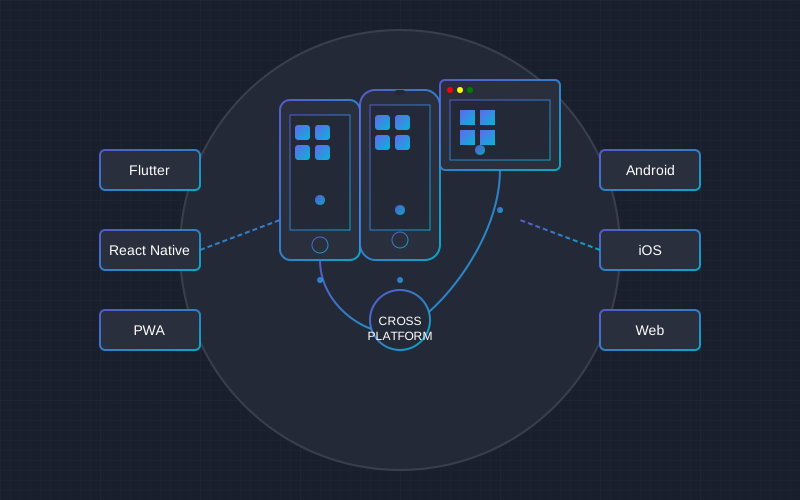
- Go cross-platform: Flutter or React Native lets you build for Android and iOS simultaneously. You can save up to 30% compared to building two separate native apps.
- Use Firebase for the backend: For small and medium projects, Firebase can replace a custom backend. Typical savings: 3,000-8,000 EUR.
- Prepare a detailed brief: The more precisely you define what you want, the less time the developer spends on questions and revisions. Changes mid-project are expensive.
- Use ready-made design systems: Material Design components instead of fully custom UI can save 2,000-5,000 EUR on design alone.
- Negotiate a fixed price: If the project scope is well-defined, push for a fixed-price contract. This protects you from "the invoice grew because it took longer" scenarios.
- Pay in milestones: Pay in stages tied to deliverables. This keeps the developer motivated and protects your investment at each step.
Here is a real example: a beauty salon wanted an app with online booking, a gallery, a loyalty program, and push notifications. The full version would have cost around 18,000 EUR. We suggested starting with an MVP -- just booking and push notifications -- for 7,500 EUR. After 3 months of strong user adoption, we added the remaining features for another 6,000 EUR. Final cost: 13,500 EUR instead of 18,000 EUR. That is 25% saved, with zero risk of building features nobody would use.
Questions to Ask Your Developer Before Signing
Before you pay any deposit, ask these questions. If the developer cannot answer them clearly, consider it a red flag.
- What happens if the project is delayed? Are there penalties, or are deadlines merely "estimates"?
- Who owns the source code? Some developers retain rights to the code. You should receive full ownership upon final payment.
- What is the post-launch support plan? A 3-month warranty should be the bare minimum.
- What technology stack will you use? Kotlin (native Android), Flutter, or React Native (cross-platform)? Each choice has long-term implications for maintenance and scalability.
- Can I see interim builds? A good developer shows progress every 1-2 weeks. If they disappear for months and then deliver a finished product, something is wrong.
Real-World Project Examples
I will skip the unicorn stories -- no one needs to hear about apps that cost millions. Here are real small and medium business cases.
Cafe chain (3 locations). Ordering app with a loyalty program. Built with Flutter, 4 months of development. Cost: 14,000 EUR. In the first 6 months, 2,300 people downloaded the app, and the average order value through the app was 15% higher than through the website. The app paid for itself in 8 months.
Auto repair shop. Booking system with reminders and service history. Native Android, 2.5 months. Cost: 9,500 EUR. No-show rates dropped from 18% to 4%. That alone saved roughly 12,000 EUR in lost revenue over the first year.
Food delivery startup. Marketplace-type app with customer and courier sides. React Native, 6 months. Cost: 38,000 EUR (including backend and admin panel). After one year: 8,000 active users and 45 partner restaurants.
When an App Is NOT the Best Solution
I will be honest -- not every business needs a native app. For some, a different approach delivers better ROI:
- PWA (Progressive Web App): If your customers use the service infrequently (once a month or less), a PWA works through the browser and costs 3,000-8,000 EUR. No app store needed.
- Telegram / WhatsApp bot: If you only need notifications and simple orders. Cost: 1,500-4,000 EUR. Fast to build, easy to maintain.
- No-code platform: Adalo, FlutterFlow -- if your budget is under 3,000 EUR and functionality is basic. But know this: scaling later will be difficult and may require a full rebuild.
We once advised a client to build a Telegram bot for 2,500 EUR instead of a 12,000 EUR native app. Four months later, the client came back: "The bot works great, but now we want a real app." They invested the 12,000 EUR knowing the product was proven. That is the smart path -- validate first, invest second.
2026-2027 Pricing Trends
A few trends I am seeing that will affect app development costs going forward:
AI is reducing part of the cost. GitHub Copilot and similar AI coding assistants are already speeding up development by 20-30%. This means basic app prices should decrease slightly or at least stabilize over the next year.
Cross-platform is becoming the standard. Flutter and React Native quality has reached near-native levels. There is increasingly less reason to pay double for separate Android and iOS builds. For most business applications, cross-platform is the pragmatic choice. You can read more about the specifics in our Flutter vs React Native comparison.
No-code will grow but will not solve everything. For simple projects, no-code platforms will increasingly suffice. For anything complex, you will still need experienced developers. The net effect: entry-level apps become more accessible, while sophisticated systems hold their pricing.
Our Forecast
Over 2026-2027, simple app prices will decrease 10-15% due to AI tools and no-code platforms. Complex system prices will remain stable or even increase, because experienced senior developers remain in high demand across Europe.
So, How Much Will Your App Cost?
Coming back to the original question. Here is a quick way to estimate:
- Count the screens -- how many distinct views will your app have?
- Do you need a backend? (user login, data storage = yes)
- Do you need payments? (add 3,000-5,000 EUR)
- Do you need third-party integrations? (each adds 1,000-3,000 EUR)
- Do you need an admin panel? (add 3,000-8,000 EUR)
Add it all up and you will have a number remarkably close to reality. Or simply reach out to us with a brief description -- we will send you a preliminary estimate within 24 hours. Free, with no obligations.
Frequently Asked Questions (FAQ)
Conclusion
Android app development in 2026 is more accessible than ever, but it is still a significant investment that requires careful planning. Start by clearly defining your needs, choose the right development approach (MVP first, always), and work with a developer who communicates transparently about costs and timelines.
The most expensive app is one that nobody uses. The most cost-effective app is one that solves a real problem, launches quickly, and evolves based on actual user feedback. Keep that principle at the center of every budgeting decision.
Want to know how much your app idea will cost?
Send us a brief description and receive a preliminary estimate with pricing and timeline within 24 hours. No obligations.
Get a free estimate