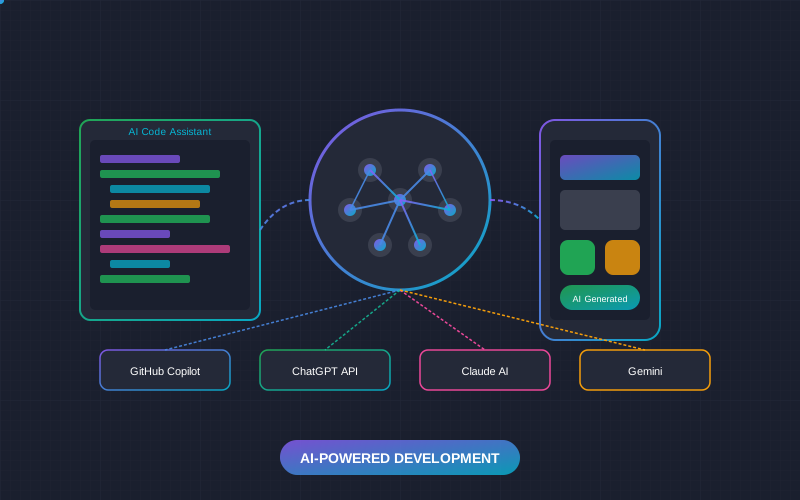
Every other client now comes with the same request: "We want AI in our app." When asked "what specifically should the AI do?" -- 7 out of 10 times the answer is: "Well... something smart."
"Something smart" is not a technical specification. But the impulse is understandable. AI is everywhere -- in the news, on LinkedIn, in competitor products. It feels like if your app does not have AI, you are behind.
But is that actually true? Let us look at what AI can realistically do in your mobile app, what it costs, and when it is just an expensive buzzword.
AI in Your App Is a Tool, Not Magic
First, let us remove the rose-colored glasses. AI will not make your app "smart" on its own. AI is a tool that solves specific problems. If there is no problem, there is no need for AI.
Think of it like a hammer. Excellent for driving nails. Terrible for sawing wood. The trick is knowing which nails AI can drive in your app.
6 AI Features That Actually Work
1. Customer Service Chatbot
This is the most popular AI feature in mobile apps, and for good reason -- it genuinely works.
The concept: a user types a question in natural language, and AI responds. Not pre-written answers (that was 2020) but a real conversation -- AI understands context, remembers previous questions, and can perform actions (cancel an order, reschedule an appointment).
For one client -- a restaurant chain with 4 locations -- we integrated a GPT-based chatbot into their app. It answers menu questions, accepts reservations, and provides allergen information. In the first 3 months, the chatbot handled 2,300 inquiries that previously required a human administrator on the phone. That saves approximately 15-20 hours per week.
Cost: 2,000 - 4,000 EUR for integration + approximately 50-150 EUR/month in API costs (depending on message volume).
2. Recommendation System
"You might also like these products" -- that is AI. The system analyzes what a user has viewed, purchased, and shown interest in, then suggests something similar.
This works exceptionally well in e-commerce, content platforms, and media apps. Amazon claims that 35% of their sales come from recommendations. Your scale will be smaller, but the principle is identical.
There is one important caveat: you need data. If your app has 100 users, the recommendation system has nothing to learn from. You need at least 1,000-5,000 active users before AI starts producing meaningful results.
Cost: 3,000 - 6,000 EUR for integration. API costs are minimal.
3. Computer Vision
Point your camera at an object, and AI identifies it. It sounds futuristic, but it already works reliably and at affordable prices.
Practical applications:
- E-commerce: a user photographs a product, and the app finds similar items in your catalog.
- Document scanning: photograph a receipt or invoice, and AI extracts the data and enters it into your system automatically.
- Quality control: in manufacturing, photograph a part and AI determines whether it meets specifications.
- Plant/animal identification: niche, but specialized apps generate real revenue from this.
We use Google Vision API or AWS Rekognition -- both work well. Cost: 2,000 - 5,000 EUR for integration.
4. Voice Commands and Transcription
"Hey, order me a margherita pizza" -- and the app understands what to do. Or more practically: dictate text, and AI transcribes it.
Where this is genuinely useful:
- Logistics apps -- drivers dictate notes instead of tapping buttons while driving.
- Medical apps -- doctors dictate notes, and AI transcribes and structures them.
- CRM systems -- sales reps dictate call summaries after each conversation.
Speech recognition has improved dramatically. Google Speech-to-Text works solidly at about 90-95% accuracy in clean speech conditions for most European languages. That is sufficient for the majority of business use cases.
Cost: 1,500 - 3,000 EUR for integration.
5. Predictive Analytics
AI analyzes historical data and predicts the future. In practice, this means:
- E-commerce: "This customer is likely to buy within 7 days" -- send them a discount.
- SaaS: "This user is probably going to cancel their subscription" -- intervene before it happens.
- Logistics: "Next week we predict 30% more orders" -- prepare accordingly.
But -- and this is critical -- predictive analytics requires a lot of historical data. At least 6-12 months of records and several thousand entries. If your business is young, there simply is not enough data to learn from.
Cost: 5,000 - 15,000 EUR (depending on complexity).
6. Personalized Content
The app adapts to each individual user. Not just "Hello, John" but genuine content personalization. The home screen shows what is relevant specifically to you. Notifications arrive when you are most likely to open them.
Spotify does this masterfully -- your "Discover Weekly" and "Daily Mix" are AI personalization. On a smaller scale, using the same principles, this can be implemented in your app too.
Cost: 3,000 - 8,000 EUR, depending on depth.
Two Paths: API Integration vs Custom Model
This is the fundamental decision that determines cost, timeline, and complexity.
| Aspect | API Integration | Custom ML Model |
|---|---|---|
| Concept | Use a ready-made AI (GPT, Claude, Gemini) | Build your own model from scratch |
| Cost | 2,000 - 5,000 EUR (integration) | 10,000 - 30,000+ EUR |
| Timeline | 1-3 weeks | 2-6 months |
| Best for | Chatbot, text generation, translation, basic analytics | Unique problems, large datasets, specific accuracy needs |
| Pros | Fast, affordable, continuously improving | Full control, uniqueness, independence |
| Cons | Vendor dependency, monthly costs | Expensive, needs specialists, needs large datasets |
Our recommendation for 90% of cases: start with API integration. GPT-4o, Claude 3.5, Gemini Pro -- these are powerful models that handle most tasks excellently. Build a custom model only when APIs are no longer sufficient or when your data is highly specialized.
Practical Example: Chatbot via GPT API
You integrate OpenAI's GPT-4o API into your app. You give it context: "You are company X's assistant. You know our products, prices, and business hours." GPT responds to customers in natural language. Integration takes 1-2 weeks. Costs 2,000 - 3,000 EUR. API costs: approximately 0.01-0.03 EUR per conversation. That means 1,000 conversations per month costs 10-30 EUR. An affordable and effective AI integration.
When AI Is Just a Buzzword
Let us be honest. There are situations where AI in your app is just a marketing gimmick, not real functionality.
You Don't Need AI If:
- Your app does not have 500+ active users yet. AI needs data. No data means nothing to learn from. Build your audience first, then think about AI.
- The problem can be solved with simple rules. "If order > 50 EUR, free shipping." That does not need AI -- a basic if/else statement works. Do not overpay.
- You want AI "for the checkbox." "Our app has AI!" sounds great in a pitch, but if users do not actually feel it, it is a waste of money.
- Your business has no repeating processes. AI works best where there are patterns and repetition. One-off situations are not AI's strength.
For one client -- a small transport company -- we said directly: "You don't need AI. You need a solid app that works without crashes and shows driver locations. Once you have that, then we can talk about route optimization with AI."
They saved 8,000 EUR that would have been spent on an "AI feature" nobody would have used.
Complete Cost Breakdown
| AI Feature | Integration Cost | Monthly API Costs |
|---|---|---|
| Chatbot (GPT/Claude) | 2,000 - 4,000 EUR | 30 - 200 EUR |
| Recommendation system | 3,000 - 6,000 EUR | 20 - 100 EUR |
| Computer vision | 2,000 - 5,000 EUR | 10 - 150 EUR |
| Voice commands | 1,500 - 3,000 EUR | 20 - 80 EUR |
| Predictive analytics | 5,000 - 15,000 EUR | 50 - 300 EUR |
| Personalization | 3,000 - 8,000 EUR | 30 - 150 EUR |
Add maintenance costs for each feature -- AI models get updated, APIs change, quality needs monitoring. Budget 10-15% annual costs of the integration price for ongoing maintenance.
ROI -- Will AI Pay for Itself?
Good question. And the answer is: it depends.
When AI Genuinely Pays Off
- Chatbot -- if your customer service costs 1,500+ EUR/month (employee salary), a chatbot that handles 50% of inquiries pays for itself in 3-6 months.
- E-commerce recommendations -- if it increases average basket size by 10-15% (realistic), and your monthly revenue is 20,000+ EUR, it pays for itself in 2-4 months.
- Document scanning -- if an employee manually enters 50+ documents daily, AI automation saves 3-4 hours per day. Pays for itself in 1-2 months.
But if your app has 200 users and monthly revenue of 3,000 EUR, a 5,000 EUR AI integration probably will not pay for itself within a reasonable timeframe. Better to invest in marketing and user acquisition first.
How to Get Started -- A Practical Plan
If you have decided that AI makes sense for your app, here is the approach we recommend:
- Identify one specific problem. Not "add AI" but "reduce customer service response time" or "increase sales through recommendations." One problem, one solution.
- Start with an API. GPT-4o, Claude 3.5 Sonnet, Gemini Pro -- choose based on your needs. For chatbots: GPT or Claude. For image recognition: Google Vision. For speech: Google Speech.
- MVP in 2-3 weeks. Do not build the full integration right away. Build a basic version, launch it, and see if users actually use it.
- Measure everything. How many messages per day does the chatbot receive? What percentage of questions does it answer correctly? How many sales came through recommendations? Without numbers, you cannot evaluate success.
- Iterate. After a month, improve. Add context, adjust responses, expand functionality. AI integration is not a one-time project -- it is an ongoing process.
Real-World Examples
Here are a few actual cases where AI in mobile apps is already delivering value:
- Medical platform -- an AI triage system that suggests which specialist to consult based on symptoms. Reduced unnecessary appointments by 20%.
- Logistics company -- route optimization via AI. 12 drivers, 80-100 deliveries per day. AI saves 15% on fuel costs by optimizing routes.
- E-commerce store -- an AI chatbot that helps choose products based on needs. "I'm looking for a gift for a 10-year-old boy, budget 30 EUR" -- and AI suggests 3-5 items from the catalog.
These are not science fiction -- they are working projects that deliver measurable results.
Should You Add AI or Not?
Here is our simple test:
3 Questions Before Integrating AI
1. Can you clearly describe what the AI will do? If the answer is "something smart" -- stop. If it is "answer customer questions about our services 24/7" -- proceed.
2. Do you have enough users/data? For a chatbot, 100 users is enough. For recommendations, you need 1,000+. For predictive analytics, 5,000+ and 6+ months of history.
3. Can you calculate the ROI? "AI will save X hours per week" or "increase conversions by Y%" -- if you can say that at least approximately, the investment makes sense.
AI in 2026 is not a luxury -- it is an accessible tool. But like any tool, it is only useful when you know what to use it for.
Frequently Asked Questions (FAQ)
Thinking about AI for your mobile app?
Let's talk for 15 minutes. We'll tell you which AI feature would deliver the most value for your business and how much it would cost. Honestly.
Get a free consultation