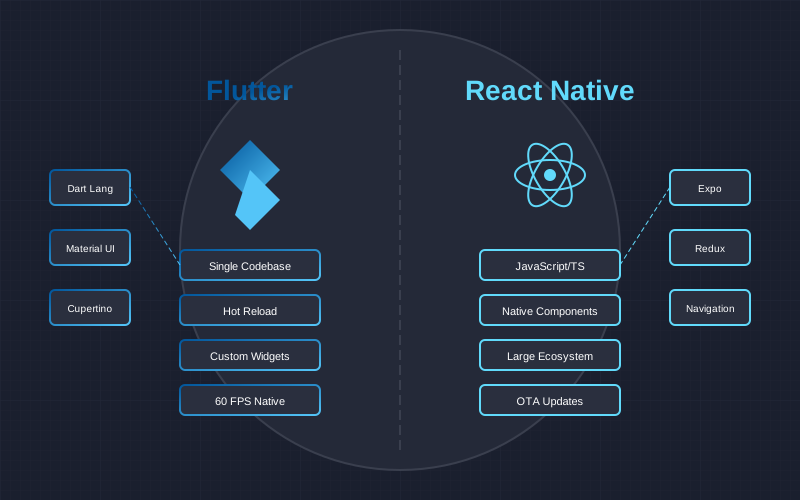
Cross-platform mobile app development has become the standard, allowing businesses to save time and money by creating one codebase for both platforms. In 2025, two frameworks dominate this space: Google Flutter and Meta (Facebook) React Native. In this article, we will comprehensively compare both technologies and help you choose the most suitable one for your project.
Technology Overview
Flutter
- Developer: Google
- Language: Dart
- Released: 2017
- UI: Custom Skia rendering widgets
- Popular apps: Google Pay, BMW, Alibaba, eBay
React Native
- Developer: Meta (Facebook)
- Language: JavaScript/TypeScript
- Released: 2015
- UI: Native platform components
- Popular apps: Facebook, Instagram, Discord, Shopify
Architecture Differences
Flutter Architecture
Flutter uses a unique architecture that differs from traditional cross-platform solutions. Instead of using platform UI components, Flutter has its own rendering engine (Skia) that draws every pixel on the screen.
Key Flutter architecture elements:
- Dart Framework - high-level widget and tool collection
- Foundation Library - base classes and functions
- Skia Engine - 2D graphics rendering engine (C++)
- Platform Channels - communication with native code
This approach provides full control over the UI and ensures identical appearance on both platforms. However, the app size may be larger since the Skia engine is included in every application.
React Native Architecture
React Native uses a "bridge" architecture that allows JavaScript code to communicate with native platform components. The new architecture (Fabric + TurboModules), released in 2024, has significantly improved performance.
React Native architecture elements:
- JavaScript Thread - executes application logic
- Native Modules - native platform functionality
- Fabric Renderer - new UI rendering system
- TurboModules - more efficient native module system
- JSI (JavaScript Interface) - direct access without bridge
Performance Comparison
Performance is one of the most important factors when choosing a cross-platform framework. The performance of both technologies in 2025 is very good, but there are important differences.
| Metric | Flutter | React Native |
|---|---|---|
| Startup time | ~1.2s (average) | ~1.5s (average) |
| FPS in animations | 60 FPS stable | 60 FPS (with optimization) |
| Memory usage | Lower | Higher (JS runtime) |
| APK/IPA size | ~15-25 MB base | ~10-15 MB base |
| Hot Reload speed | ~0.5s | ~1s |
| CPU usage | Lower | Medium |
Important to Know
In practice, both technologies perform well enough for 95% of applications. Performance differences become noticeable only in very intensive animations, games, or applications with large amounts of data.
Developer Experience (DX)
Flutter DX
Dart Programming Language
Dart is a modern, object-oriented language created by Google. It is easy to learn, especially for programmers with Java, C#, or JavaScript experience.
Dart advantages:
- Null Safety - protection against null pointer errors
- AOT and JIT compilation - fast development and optimal production
- Asynchronous programming - async/await, Futures, Streams
- Strong typing - fewer runtime errors
Widget System
Flutter uses a declarative UI model where everything is a widget. This provides consistency and easy composition but requires a different mindset than traditional imperative UI.
Hot Reload
Flutter Hot Reload is one of the fastest - changes are visible in ~0.5 seconds while preserving application state. Stateful Hot Reload allows changing code without restarting the application.
React Native DX
JavaScript/TypeScript
React Native uses JavaScript or TypeScript - the most widespread programming languages in the world. This means most developers already know these technologies.
JavaScript/TypeScript advantages in React Native context:
- Massive ecosystem - NPM packages, libraries
- Familiarity - most already know JS
- Code sharing - with React web applications
- TypeScript support - static typing when needed
React Paradigm
If you already know React web, React Native will be a very natural transition. Component model, hooks, state management - everything works similarly.
Ecosystem and Libraries
| Aspect | Flutter | React Native |
|---|---|---|
| Package count | ~40,000+ (pub.dev) | ~100,000+ (npm) |
| GitHub stars | ~165,000 | ~120,000 |
| Stack Overflow questions | ~150,000 | ~100,000 |
| Official components | Comprehensive set | Basic set |
| State management | Provider, Riverpod, BLoC | Redux, MobX, Zustand |
| Navigation | Navigator 2.0, GoRouter | React Navigation |
Flutter Ecosystem
Flutter ecosystem is growing rapidly. The official pub.dev package has strict quality evaluation, so library quality is generally higher on average. Google actively develops official packages for Firebase, Maps, and Ads integrations.
React Native Ecosystem
React Native uses the npm ecosystem, which is the largest in the world. You can find a package for almost any functionality. However, quality varies greatly - you need to carefully evaluate libraries.
UI/UX Capabilities
Flutter UI
Flutter provides absolute control over every pixel. Since it uses its own rendering engine, you can create any design regardless of platform limitations.
- Material Design 3 - full Google Material support
- Cupertino widgets - iOS-style components
- Custom widgets - easy creation from scratch
- Animations - powerful and smooth 60 FPS
- Consistency - identical UI on both platforms
React Native UI
React Native uses real native platform components, so the application automatically looks "native" on each platform. However, implementing custom designs can be more challenging.
- Native components - real platform look & feel
- Platform-specific UI - easy adaptation
- Third-party libraries - React Native Paper, NativeBase
- Animations - Reanimated 3 provides native performance
Pricing in the Market
| Project Type | Flutter Price | React Native Price |
|---|---|---|
| Simple app (MVP) | 7,900 - 15,000 EUR | 7,900 - 15,000 EUR |
| Medium complexity | 2,000 - 8,000 EUR | 2,000 - 8,000 EUR |
| E-commerce app | 5,000 - 15,000 EUR | 5,000 - 15,000 EUR |
| Enterprise solution | 15,000 - 50,000+ EUR | 15,000 - 50,000+ EUR |
| Hourly rate | 25 - 50 EUR/hour | 25 - 50 EUR/hour |
Prices are similar because development time for both technologies is comparable. Differences arise from developer experience and specific project requirements.
When to Choose Flutter?
Flutter is a better choice when:
- Identical UI on both platforms is needed - branding, unique design
- Team has no React experience - Dart is easy to learn
- Maximum performance is important - animations, games
- Planning web and desktop versions - Flutter multi-platform
- Want a single codebase - less platform-specific code
- Building a startup - faster development cycle
When to Choose React Native?
React Native is a better choice when:
- Team already knows React/JavaScript - quick start
- You have a React web application - code sharing
- Need many native modules - larger ecosystem
- Native look & feel is important - platform components
- Large project with existing infrastructure - integration
- Need JavaScript specialists - easier to find in the market
WebXpert Recommendation
Our experience shows that Flutter is better suited for new projects and smaller teams due to faster development cycle and simpler architecture. We recommend React Native for teams that already have React experience and want to maximize the JavaScript ecosystem.
Future Perspectives
Flutter 2025+
Google actively invests in Flutter. Latest directions:
- Impeller - new rendering engine, even faster than Skia
- WASM - web application performance improvement
- Foldable devices - support for flexible screens
- AI integration - Gemini and ML Kit
React Native 2025+
Meta continues to improve React Native:
- New Architecture - full transition to Fabric/TurboModules
- Static Hermes - even faster JavaScript engine
- React 19 support - latest React features
- Expo SDK - more native capabilities without ejection
Frequently Asked Questions (FAQ)
Conclusions
Flutter and React Native in 2025 are both mature, powerful technologies suitable for professional mobile app development. The choice depends on your team's experience, project specifics, and long-term goals.
Choose Flutter if you're starting a new project, want consistent UI on both platforms, and plan to expand to web/desktop.
Choose React Native if you have JavaScript/React experience, need deep native integration, and want to leverage the largest npm ecosystem.
In both cases, you'll get a professional, fast application running on iOS and Android for significantly less cost than native development.
Not sure which technology to choose?
Contact us for a free consultation and get a professional assessment of which technology best suits your business needs.
Get Free Consultation