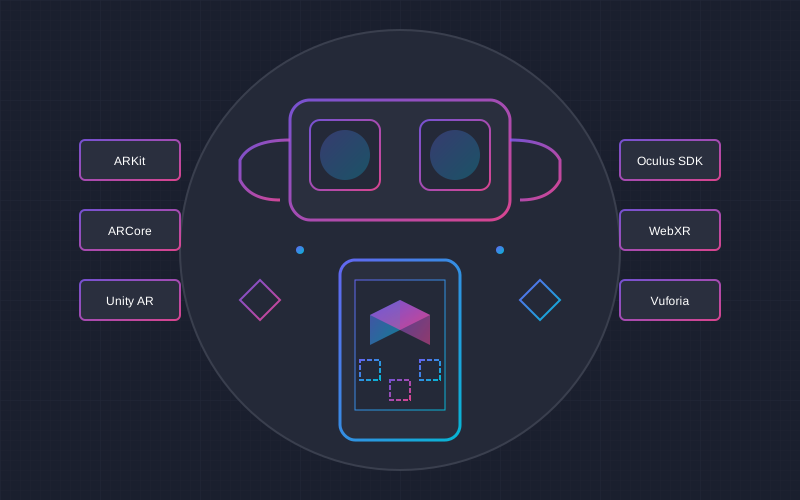
Augmented Reality (AR) and Virtual Reality (VR) are no longer just futuristic technologies from science fiction movies. Today, they are becoming real business tools that can transform customer experience, increase sales, and optimize internal operations. In this article, we will discuss how businesses can practically use AR and VR technologies in their mobile applications.
AR vs VR: Key Differences
Before diving into technical details, it's important to understand the fundamental differences between these two technologies, as they solve different business problems and require different resources.
Augmented Reality (AR)
AR enhances the real world with digital elements. Users see their environment through a phone camera or special glasses, with virtual objects, information, or animations overlaid on top.
- Devices: Smartphone, tablet, AR glasses (Microsoft HoloLens, Apple Vision Pro)
- Accessibility: Wide - works on most modern phones
- Use cases: Product visualization, navigation, interactive marketing
- User experience: Can be used anywhere, anytime
Virtual Reality (VR)
VR completely immerses the user in an artificial 3D environment. The real world is replaced by a virtual one, creating a highly engaging experience.
- Devices: VR headsets (Meta Quest, HTC Vive, PlayStation VR)
- Accessibility: Limited - requires special equipment
- Use cases: Training, simulations, virtual tours, games
- User experience: Requires a calm environment and time
| Aspect | AR (Augmented Reality) | VR (Virtual Reality) |
|---|---|---|
| Reality | Enhances the real world | Replaces the real world |
| Devices | Phone, tablet, AR glasses | VR headset |
| User cost | Low (already have a phone) | High (300-1500 EUR for VR headset) |
| Reach | ~90% of smartphones | ~5% of users have VR |
| Usage duration | A few seconds to minutes | 15-60+ minutes |
| Mobility | Full - use anywhere | Limited - needs space |
| Development cost | From 2,000 EUR | From 10,000 EUR |
WebXpert Recommendation
For most businesses, we recommend starting with AR solutions because they reach a much larger audience (all smartphone users) and require smaller investments. VR is suitable for specific cases: complex training, real estate, or entertainment.
Key AR/VR Technologies for Mobile Applications
ARKit (Apple)
Apple's AR platform for iPhone and iPad devices. Offers powerful features with excellent optimization within the Apple ecosystem.
- Surface detection: Automatically recognizes floors, tables, walls
- Face tracking: Tracking of 52 facial muscles in real-time
- Object occlusion: Virtual objects can be behind real objects
- LiDAR support: Precise depth measurement on Pro devices
- Cloud anchoring: AR objects remain in the same location
iOS 11+ iPhone 6s+ Swift RealityKit
ARCore (Google)
Google's AR platform for Android devices. Supports hundreds of Android phone models.
- Motion tracking: Precise phone position tracking in space
- Environmental understanding: Detection of horizontal and vertical surfaces
- Light estimation: Virtual objects reflect real lighting
- Cloud anchoring: AR experiences across multiple devices
- Depth API: 3D environment understanding without LiDAR
Android 7.0+ Kotlin/Java Sceneform
Unity + AR Foundation
Cross-platform solution that allows creating one AR application for both platforms. Ideal choice when you need to support both iOS and Android.
- One codebase: One application works on ARKit and ARCore
- 3D engine: Powerful graphics engine for complex graphics
- Asset store: Thousands of ready-made 3D models
- VR support: The same project can be adapted for VR
- C# programming: Popular, easy-to-learn language
Cross-platform C# Unity Engine
Unreal Engine
The most powerful 3D engine for photorealistic graphics. Used in AAA games and highest quality VR projects.
- Photorealism: Nanite and Lumen technologies for cinematic quality
- MetaHumans: Hyperrealistic human models
- Blueprints: Visual programming without code
- VR optimization: Excellent performance on VR devices
High-end VR C++ Blueprints
AR/VR Applications by Industry
Retail
- Virtual furniture try-on: IKEA Place-style feature - place furniture in your room before buying
- Cosmetics try-on: Sephora Virtual Artist - try makeup in real-time
- Clothing fitting: Virtual clothing overlay on your image
- Product demonstrations: 3D product viewing from all angles
ROI: 40% higher conversions, 25% fewer returns
Real Estate
- Virtual tours: View apartments from anywhere in the world
- Interior visualization: See different furniture arrangements
- Construction projections: AR visualization at construction sites
- 3D floor plan viewing: Walk through an unbuilt building
ROI: 50% fewer physical viewings, faster sales
Education and Training
- Interactive lessons: 3D anatomy, chemistry, physics models
- Historical reconstructions: Virtual tours of historical sites
- Professional training: Safe simulations for dangerous professions
- Language learning: Engaging VR conversations with virtual characters
ROI: 75% better information retention
Manufacturing and Logistics
- Technical staff training: AR instructions directly on equipment
- Maintenance guides: Step-by-step repair instructions
- Warehouse navigation: AR path to the required item
- Quality control: AR measurement overlays on products
ROI: 30% faster training, 50% fewer errors
Healthcare Sector
Although this is a specific niche, AR/VR in healthcare is growing rapidly:
- Surgery planning: 3D visualization of patient anatomy before surgery
- Medical student training: Virtual surgeries without risk to patients
- Rehabilitation: VR games for physical therapy
- Psychotherapy: VR exposure therapy for treating phobias
Market Examples and Opportunities
There are excellent opportunities for AR/VR technology implementation in any market. Here are some areas where businesses could lead:
Furniture and Interior Sector
Furniture manufacturers can create a competitive advantage by offering AR visualization:
- Visualization of sofas, beds, tables in customer's home
- Color and material changes in real-time
- Accurate dimensions with AR measurement feature
- E-shop integration - direct ordering from AR
Real Estate Agencies
The real estate market is perfectly suited for VR tour implementation:
- Attracting foreign buyers - diaspora can view apartments remotely
- New construction projects - sell apartments in an unbuilt building
- Time saving - filter serious buyers before physical visits
Tourism and Cultural Heritage
Historical heritage can be revived with AR technologies:
- Castle reconstructions: AR reconstruction of how castles looked centuries ago
- Old town tours: Historical characters telling stories
- Historical sites: Interactive AR information about landmarks
- Museums: Exhibit revival with AR animations
Success Story: Scandinavian Furniture Manufacturer
A Scandinavian furniture manufacturer, similar in size to a medium-sized furniture company, implemented an AR visualization feature in their application. Results after 6 months:
- Conversions increased by 29%
- Returns decreased by 35%
- Average order size increased by 18%
- Investment paid off in 4 months
AR/VR Solution Development Costs
| Solution Type | Cost | Duration | What's Included |
|---|---|---|---|
| Basic AR | 2,000 - 5,000 EUR | 2-4 weeks | One AR scenario, 5-10 product models, one platform |
| Medium AR | 5,000 - 15,000 EUR | 1-3 months | Multiple scenarios, 50+ models, iOS + Android, analytics |
| Advanced AR | 15,000 - 30,000 EUR | 3-5 months | Complex scenarios, AI integration, real-time configurator |
| Basic VR | 10,000 - 25,000 EUR | 2-4 months | One VR experience, basic interaction, one device type |
| Professional VR | 25,000 - 75,000 EUR | 4-8 months | Complex simulations, multiplayer, multiple platforms |
| Enterprise VR | 75,000+ EUR | 6-12 months | Full training platform, CMS, analytics, system integration |
Additional Costs
- 3D model creation: 50-500 EUR per product model (depending on complexity)
- 3D scanning: 100-300 EUR for scanning a physical object to 3D
- Monthly maintenance: 200-1,000 EUR/month (updates, servers, bug fixes)
- Cloud infrastructure: 50-500 EUR/month (3D model storage and delivery)
Important to Know
3D model creation is often the most expensive part of an AR project. If you have a 1,000 product catalog, model creation alone can cost 50,000-500,000 EUR. We recommend starting with 10-20 most popular products and expanding gradually.
AR/VR Project Implementation Stages
1. Research and Planning (1-2 weeks)
- Target audience analysis
- Competitor AR/VR solution evaluation
- Technology selection (ARKit, ARCore, Unity)
- Functionality specification
- ROI calculation
2. Design and UX (2-4 weeks)
- AR/VR experience flow design
- UI element design in AR environment
- 3D model style guidelines
- Prototype creation and testing
3. 3D Content Creation (2-8 weeks)
- 3D model creation or scanning
- Texture and material creation
- Animation creation
- Optimization for mobile devices
4. Development (4-12 weeks)
- AR/VR functionality programming
- Integration with existing application
- Backend infrastructure creation
- Analytics integration
5. Testing and Launch (2-4 weeks)
- Testing on various devices
- Performance optimization
- Beta testing with real users
- Store submission (App Store, Google Play)
Technical Requirements and Limitations
ARKit (iOS) Requirements
- Minimum devices: iPhone 6s, iPad (5th gen), iPad Pro
- iOS version: iOS 11.0 or newer
- LiDAR features: iPhone 12 Pro+, iPad Pro 2020+
- Reach: ~50% of smartphone users
ARCore (Android) Requirements
- Android version: Android 7.0 (API level 24) or newer
- Supported devices: Hundreds of models (Samsung, Xiaomi, OnePlus, etc.)
- Reach: ~40% of smartphone users
- Note: Not all Android phones support ARCore
Performance Optimization
- 3D model size: Recommended up to 10MB per model
- Polygon count: 50,000-100,000 triangles per object
- Textures: 1024x1024 or 2048x2048 pixels
- Frame rate: Target 60 FPS for smooth experience
Frequently Asked Questions (FAQ)
Conclusions and Recommendations
AR and VR technologies are no longer a vision of the future - they are today's tools that can provide real competitive advantage for businesses. Here are the main recommendations:
- Start with AR: Larger audience, smaller investment, faster payback
- Choose the right niche: Furniture, real estate, education - areas with clear ROI
- Invest in quality: A poor AR experience damages your brand
- Measure results: Track conversions, time spent, user retention
- Expand gradually: Start with 10-20 products, not the entire catalog
The market is perfectly suited for AR experiments - small enough to test, technologically advanced enough to embrace innovations. Businesses that implement AR solutions today will have a clear advantage over competitors tomorrow.
Want to create an AR solution for your business?
Contact us for a free consultation and learn how AR technologies can increase your sales and improve customer experience.
Get a free consultation